Play reduces stress and lifts wellbeing – and adults benefit as much as children do
Somewhere along the way to adulthood, time to play fades away. We tend to trade silliness and imagination for seriousness and busyness.
Yet there is clear evidence that adults benefit from playfulness just as children do.
Research shows that adults who engage in playful activities tend to cope better with stress, experience more positive emotions, show greater resilience when facing challenges, and report higher levels of life satisfaction.
Our research with New Zealand families highlights how supporting unstructured play can help adults feel less stressed and more connected, while also normalising playfulness in everyday family life.
In a world that demands constant busyness, play offers essential qualities we are at risk of losing: spontaneity, togetherness and the freedom to have fun.
Play in adulthood can look different from play in childhood. It is less about toys or games and more about how we approach everyday experiences.
Adult play can be physical, social, creative or imaginative. It might involve movement, music, humour, storytelling, problem-solving or simply doing something for the pleasure of it.
What makes an activity playful is not its form, but the mindset behind it: curiosity, openness and a willingness to engage without a fixed outcome. For adults, play is often woven into hobbies and moments of exploration that sit outside work and obligation.
The benefits of play in adult life
A recent study suggests a potential neurobiological pathway between playfulness and cognitive health in older adults.
At its core, play provides a space to reset, allowing us to step outside pressure and performance. In doing so, it supports not only stress regulation, but sustains emotional balance and quality of life across adulthood.
The value of playfulness also goes beyond the individual. Playful engagement in social contexts helps build shared emotional resources, shaping how people interact and cope together over time.
Playfulness in adults is also associated with higher emotional intelligence, including stronger ability to perceive and manage emotions in social situations. Observational studies further show that adults who engage playfully are more empathetic, reciprocal and positive in their interactions with others, reinforcing social connection and belonging.
Importantly, play has a unique ability to cut across age boundaries. When adults and children play together, even if unrelated, differences in age, role and status tend to fade, replaced by shared enjoyment and interaction.
Research suggests these inter-generational play experiences can strengthen relationships, support wellbeing and reduce age-based stereotypes. Play becomes a shared language, bridging age divides that are often reinforced by modern living.
As our work highlights, unstructured play remains both possible and meaningful in contemporary life, with families reporting benefits for children’s development as well as family cohesion and shared wellbeing. These findings suggest play can function as an ordinary, rather than exceptional, feature of family and community life.
Making room for play in everyday life
If play matters across the lifespan, the spaces we inhabit need to support it.
Yet most public environments continue to treat play as something designed primarily for children. Research in urban design suggests the most effective playful environments for adults are those that don’t announce themselves as playgrounds, but instead embed playful possibilities into everyday settings.
Features such as oversized steps, stepping stones, interactive seating or winding paths can invite exploration, balance and movement. In some cities, this extends to adult-sized play elements integrated into public space, such as musical swings that turn routine movement into playful interaction.
Despite these examples, play-oriented design remains the exception rather than the norm, with most public play infrastructure still concentrated in children’s spaces. Designing cities that invite adult play as part of everyday life could be a valuable investment in inclusion, social connection and population wellbeing.
Environments that support play are not just physical, but social. Just as urban design can invite or discourage playful movement, social norms shape whether play feels acceptable in adult life.
When play is treated as embarrassing, indulgent or something to apologise for, it quickly disappears. But when playful behavior is visible and unremarkable, it becomes easier for others to participate.
Play has long been treated as something separate from adult life, confined to childhood or reserved for rare moments of leisure. Yet the evidence suggests playfulness continues to matter well beyond early development.
Reframing play as a legitimate part of adult life opens up new ways of thinking about wellbeing across the lifespan.
February 16, 2026
source: theconversation.com
~ ~ ~ ~ ~ ~ ~ ~ ~ ~ ~ ~ ~ ~ ~ ~ ~ ~ ~ ~ ~ ~ ~ ~ ~ ~ ~ ~ ~ ~ ~ ~ ~ ~ ~ ~
How to find joy through play as an adult
~ ~ ~ ~ ~ ~ ~ ~ ~ ~ ~ ~ ~ ~ ~ ~ ~ ~ ~ ~ ~ ~ ~ ~ ~ ~ ~ ~ ~ ~ ~ ~ ~ ~ ~ ~
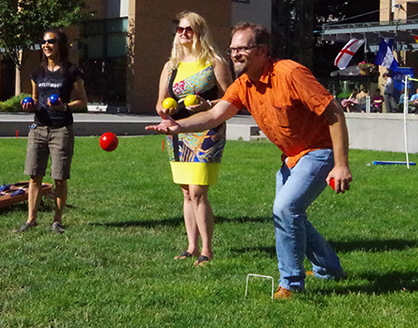
Newsflash: Grown-Ups Need Play Dates, Too
In fact, play is essential to our sanity. Here’s how to honor your inner kid.
As a kid, your life likely revolved around playtime. Climbing a jungle gym burned off energy, doing puzzles or making art challenged you to think creatively and find your flow state, and building a fort with your friends encouraged you to cooperate with others and work through conflicts. You probably didn’t realize it then, but all of these activities revealed a ton about who you are—athletic, clever, imaginative, or courageous. Play taught you how to learn, share, negotiate, and pursue your passions.
But as an adult, can you remember the last time you painted something other than a wall, jumped rope outside of the gym, or tossed around a Frisbee with your friends? When did you last have a chance to let loose and have fun?
Growing up often means trading in Neverland for real-world problems: working, raising a family, paying bills. So we focus less on having fun and more on getting things done. “If you look at much of our culture, we honor performance, results, and responsibility,” says psychiatrist Stuart Brown, MD, a leading play researcher and founder of the National Institute for Play. “There is huge pressure to see play as nonessential, as frivolous, as nonsense.”
He argues, however, that play is not only essential to our well-being but also an “important part of being fully human.” And after reviewing all of the science, we’re firmly on Team Play too.
What Does ‘Play’ Mean as an Adult?
Brown says trying to define play is a bit like trying to define love: It looks and feels different for everyone. “Whatever is experienced as joyful can be thought of as playful,” he says. “It’s done for its own sake. It’s pleasurable. It takes one out of a sense of time. It is done without the urge to accomplish something.”
The activities you loved as a kid certainly can fit the bill: finger painting, playing tag, climbing rocks and trees. But playtime as an adult can be more expansive: knitting a sweater or sewing a quilt, baking sourdough bread from scratch, devouring your to-be-read list, or hosting dinner parties and karaoke nights.
Play is simply your pathway to good vibes
-feelings like awe, joy, amusement, and gratitude.
Peter Gray, PhD, a research professor of psychology and play researcher at Boston College, notes that playful activities for adults usually involve some structure without sacrificing creativity. For example, if you’re into gardening, you follow certain steps to get seedlings to sprout, but there are endless ways to organize and care for your plants. You get to call the shots.
And best of all, if your pottery class turns out to be more stressful than soothing, you can just quit. With play, there are no major stakes, says Emiliana Simon-Thomas, PhD, science director of the Greater Good Science Center at the University of California, Berkeley, and leading expert on the psychology of emotions that bolster human happiness. This activity doesn’t come with serious goals (no quotas or 360-degree reviews here!) and shouldn’t impact your income or livelihood. (That’s why a side hustle does not count as play.) Play is simply your pathway to good vibes—feelings like awe, joy, amusement, and gratitude.
Playtime as Self-Care
Humans have always found time for fun. Even hunter-gatherer bands of the Paleolithic period (across various regions, including Africa, Asia, and South America) were playful through their daily work, Gray theorizes. Research suggests their “to-do lists” were varied and challenging, and they completed tasks among friends. Here’s how play benefits 21st-century homo sapiens.
It nourishes your brain. Brown says research (largely done in rats) suggests that our brains “light up” with positive activity in lighthearted, adventurous, or whimsical moments. “Play activates circuits in the subcortex—areas we share with other highly playful mammals,” he explains, including dogs and chimps. “These circuits trigger joy, motivation, and social bonding. Once activated, they send signals to many parts of the brain at once: areas that control movement, emotion, planning, and empathy.” In other words, joyfully playing kickball or building a sandcastle as a kid forged connections between your nerve cells, which helped your brain solidify physical and cognitive skills. Maintaining this sense of playfulness as you age reinforces these neural pathways, particularly those that help you handle stress, Brown says.
It’s a natural antidepressant. “We adults, just as is true for kids, would be a lot less anxious and depressed if we played,” Gray says. Say you’re spiraling about paying the bills piled up on your kitchen counter. Stepping away for a minute to play a bit of tennis or tend to your houseplants disrupts your mental catastrophizing, allowing you to come back to your budget sheets with a refreshed attitude. “That break opens up the mind to new possibilities,” Gray explains.
It can change your outlook for the better. Positive emotions (like the ones you get from playing) can also temporarily “undo” negative emotions triggered by unpleasant experiences, Simon-Thomas says. When you’re giggling instead of fixating on your frustration, your mindset shifts for the better and you’re better able to cope with the situation at hand.
It’s an antidote to the loneliness epidemic. This is because playing is inherently social. Joining a local softball league or hip-hop dance class allows you to hang out with people you may not have met otherwise. “There’s value in building relationships through a shared activity,” Simon-Thomas says. Even when you lose to an opposing team or group, “the whole premise is, we shake hands afterward.”
In short, play makes you a more resilient, optimistic, and authentic version of yourself. “If you’re happy, you are bringing happiness to the people around you,” Gray adds.
Letting Loose as a Grown-up
Getting back into play is like riding a bike: a bit daunting at first, but exhilarating once you pick up speed. Here’s how to loosen up and inject more joy into your life.
Explore your “play personality.”
Play is a state of being, so it tracks that your “play personality,” as Brown calls it, could be wildly different than that of your best friend, sibling, or partner. Reading Emily Henry’s latest rom-com novel, for example, might be a blast for some and mind-numbing for others.
Brown has identified eight broad types of play personalities to help people find their niche. Maybe you’re a “collector” who’s passionate about antique knickknacks or vinyl records. Or a “competitor” who gets a thrill out of hitting a PR. Perhaps you’re an “explorer” who thrives on visiting new places, or a “creator” who feels happiest while cross-stitching or woodworking. Understanding your play personality can help you narrow down what you want to explore on the reg. (More on that below.)
Revisit your childhood.
If you’re overwhelmed by possibilities, start small. Brown recommends thinking about what excited you as a kid. If you looked forward to marching band practice, maybe it’s time to pick up an instrument again. Or if you spent a ton of time outdoors, reflect on how you’d like to reconnect with nature now, whether that’s with a hiking club or birding group or learning how to press flowers.
Dare yourself a little.
When children play, they’re consistently challenging themselves. That’s one reason why it’s so valuable to their development, Gray says.
Adults should do the same. When Gray rides his bicycle, for example, he ups the ante by riding faster or longer. He’ll also explore new paths in different neighborhoods, or get a little lost so he has to find his way home. “Play involves an active mind, but not a stressed mind. You’re creating challenges just for the fun of creating challenges,” he explains. “They’re not threatening, because if you fail, it’s just play. Nobody’s judging you.”
Microdose joy wherever possible.
Play is largely about attitude, Gray says. If you have minimal time to dedicate to having fun (trust us, you’re not alone), trying to make everyday life more playful can go a long way. Ask your teen if you can try out Minecraft or Fortnite with them. Blast some tunes and dance around while folding laundry or mopping. Doodle each item on your to-do list. Pack up your dinner and eat it in the park while watching the sunset. Give yourself permission to laugh with someone you love after a hard day.
When you remember that life is meant to be enjoyed, Simon-Thomas says, it’s easier to let go of the seriousness that can drag down our day to day. Gray agrees: “Just think for a moment. What is the purpose of life? And what would life be if you’re not enjoying it—what would be the point?”
By Alisa Hrustic May 21, 2025
source: www.oprahdaily.com

